
These Jupyter notebooks let you work through the models of the open textbook Economic Principles in Cell Biology yourself.
They run right here in your browser: Python executes on your own computer, so there is nothing to install.
Exercises
-

Optimization of metabolic states
Use a small toy model to find the metabolic state that reaches a given flux with the least total enzyme. See why the optimum always lies at an elementary flux mode, and how enzyme kinetics and external conditions decide which mode wins.
-

The enzyme cost of metabolic fluxes
Find the optimal enzyme allocation in a two-step pathway: first maximize the flux for a fixed enzyme budget, then minimize the enzyme cost for a fixed flux.
-
Principles of cell growth
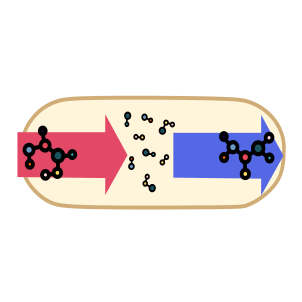
Build and solve the ODE model of a coarse-grained, self-replicating bacterial cell. Use it to reproduce Monod's law, vary the nutrient quality, and see how a drug that inhibits protein synthesis shifts the ribosomal fraction.
Your edits are saved in this browser only. To keep a copy, use File > Download inside the notebook. The first time you run a cell, loading Python can take a few seconds.
About the exercises
The notebooks accompany chapters of Economic Principles in Cell Biology, an open access textbook on how cells allocate their limited resources. They were kindly provided by authors of the book.
The GitLab repository holds notebooks for more chapters, including cell metabolism, flux balance analysis, flux variability and dynamic optimization. It also has tutorials on Python, Jupyter notebooks and linear algebra, and a Docker container with every package preinstalled. Notebooks that need specialized packages, such as COBRApy, can run locally or in the container.